How did a three-year-old startup in Taiwan score multiple orders from major hospitals in Thailand? V5med transformed semiconductor defect detection AI for lung cancer screening, achieving 95% accuracy and dual Taiwan-U.S. FDA certifications. In Thai hospital tests, V5med outperformed GE and Chinese competitors.
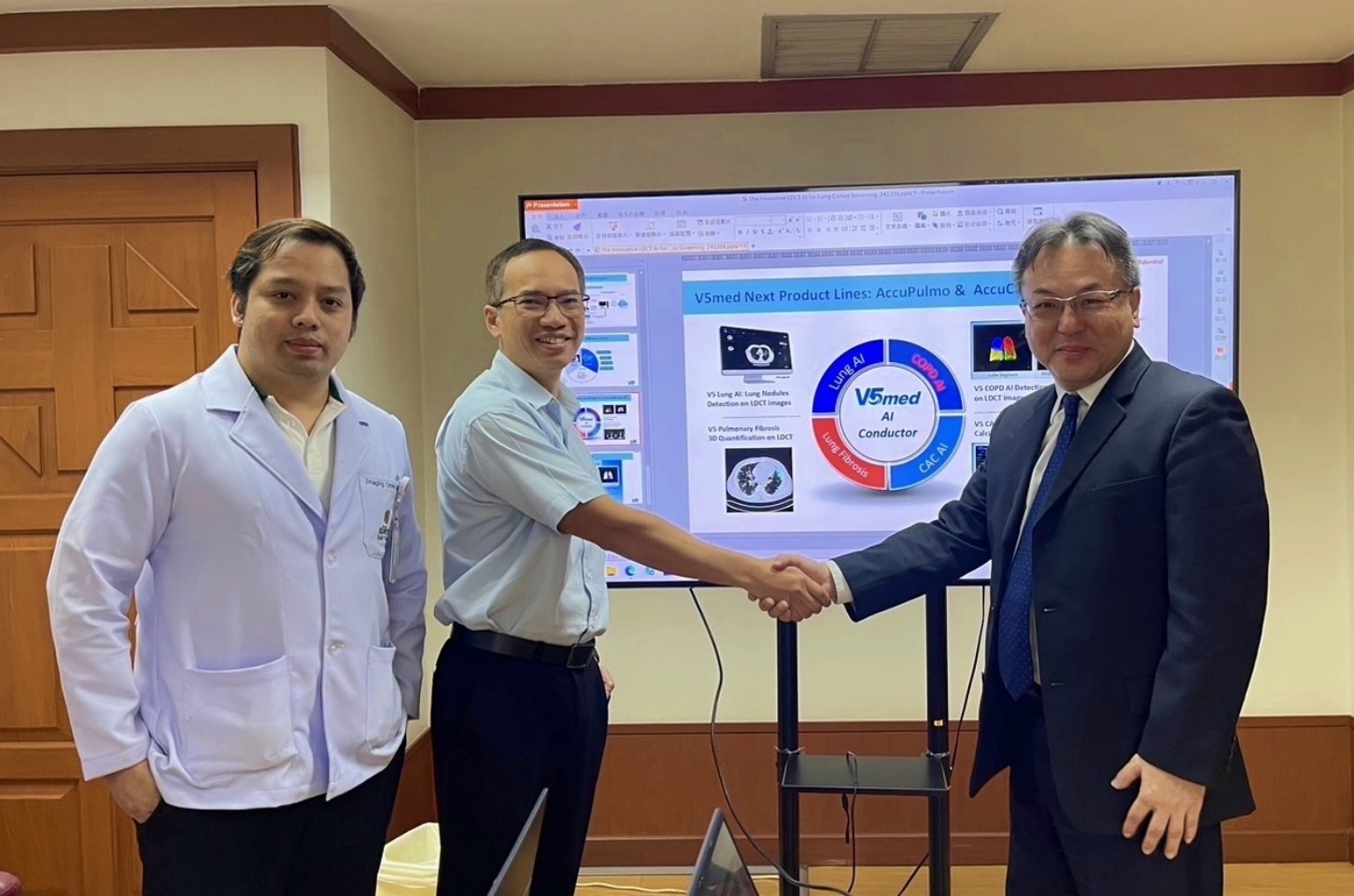
V5med partners with Bangkok Dusit Medical Services. (Photo courtesy of V5med)
V5med, a spin-off of semiconductor inspection innovator V5 Technologies, transformed AI imaging technology for healthcare applications. Its lung nodule detection system achieved both Taiwan's TFDA and U.S. FDA approvals by March 2025, making V5med the first Taiwanese provider of AI-based lung cancer imaging detection solutions to hold dual certifications from both Taiwan and the United States.
In recent years, V5med Inc. has responded to the Taiwan Ministry of Health and Welfare's "Healthcare Leads Industries Initiative" policy by expanding operations into ASEAN countries, with a keen focus on Thailand. Their products have been adopted and are currently being tested by three major private hospitals and numerous public hospitals in Thailand.
The Institute for Biotechnology and Medicine Industry (IBMI) recently interviewed James Lee, the Chief Operating Officer of V5med, to gain valuable insights into the company’s exciting endeavors in the Thai market.
“We specialize in semiconductors, specifically in detecting wafer defects as small as a few nanometers. Since lung nodules are considerably larger in both diameter and volume than these wafer defects, applying AI originally developed for wafer defect detection to lung nodules has proven to be clinically effective. The screening accuracy exceeds 95%,” says Lee. He also points out that there are already many startups in the MedTech space. He advises that Taiwanese companies looking to expand overseas should, particularly in the early stages, showcase their core technological strengths as the best competitive advantage.
Starting with Leading Hospitals and KOL Physicians
Lee suggested that while startups could pursue direct cooperation with foreign hospitals, this process often takes a considerable amount of time. Instead, starting with a partnership between Taiwanese and Thai hospitals would be a more efficient approach. V5med began establishing communication channels with Thai medical professionals by hosting smart healthcare seminars in Bangkok in collaboration with the Changhua Christian Hospital, a private medical center located in central Taiwan.
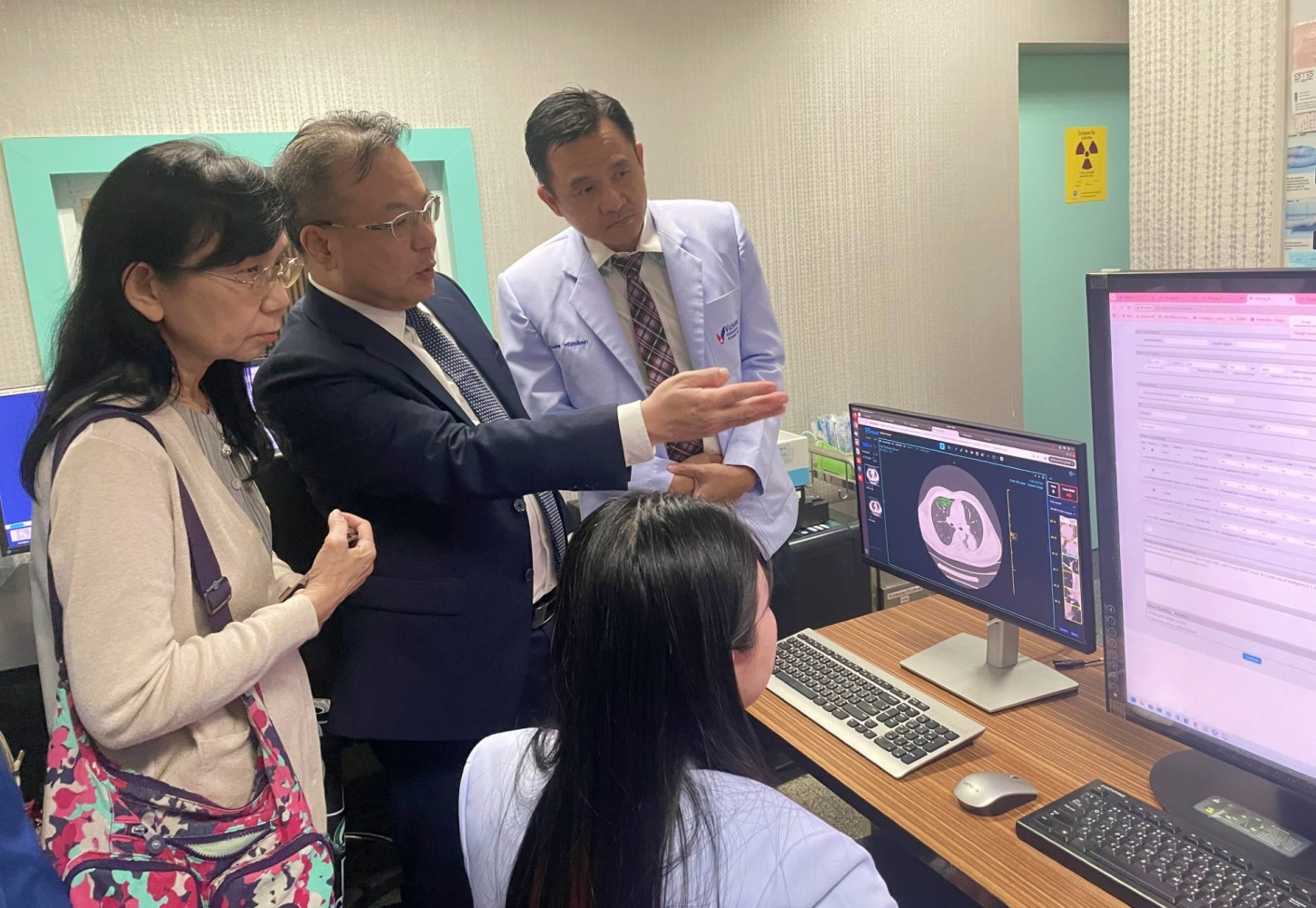
Thai radiologists use V5med's AI software. (Photo courtesy of V5med)
However, having a contact person alone is insufficient. Lee believes that to successfully enter the Thai market, it is essential to connect with key figures who can substantially boost the company’s own efforts. “When expanding overseas, having the support of key opinion leaders (KOLs), such as Professor Pan-Chyr Yang in the field of lung cancer, is vital. We need leading physicians or professors to advocate for Taiwanese products as part of the promotion strategy,” he stated clearly.
To intelligently locate these KOLs, Lee suggested reaching out to local medical associations, as they can often facilitate connections. Existing distribution partners in ASEAN countries can also provide valuable assistance. Additional support comes from Taiwan’s "Healthcare Leads Industries Initiative" policy that aims to enhance market access in the medical sector through referrals between hospitals and doctors. This approach is particularly beneficial for Taiwanese startups. "After all, doctors have a mutual respect for one another. They share a common language that improves communication and acceptance in international settings," Lee added.
Adjusting Services and Products to Local Needs
Lee lists “flexibility” as a top priority, adjusting products and services wherever needed. "When introducing a product to a country, it's crucial to approach it with sincere humility and be highly flexible to customize. Do Taiwanese people have the same lung health conditions as Thais? Does what work for Malaysians also work in Thailand? We prefer not to take a position prematurely. We want to verify in person!“ Lee explained. ”That’s why we initially collaborate with some Thai hospitals for pilot studies. Using CT scans from dozens of Thai patients, we test whether adjustments are needed before further validation and scaling up. We don’t skip any important step required in the process."
During the detailed calibration phase, the technological advantages of V5med were clearly demonstrated. Lee recalled that a well-known teaching hospital in Thailand tested three systems from international vendors simultaneously: V5med, GE, and United Imaging from Shanghai. Doctors compared the accuracy rates using the same screening images. "V5med had the highest accuracy rate," Lee stated confidently. "These comparisons occur frequently because medicine is a very rigorous industry. No doctor will accept a new product solely based on its international certifications. Doctors need to test it themselves. You must be prepared for thorough testing in overseas promotion campaigns."
Lee also highlighted that V5med not only offers high accuracy in AI interpretation but also ensures that its AI analysis technology is compatible with imaging systems from major international manufacturers, such as Siemens and GE. This seamless compatibility across CT equipment brands provides hospitals with greater convenience.
V5med has started securing orders from Thai hospitals by leveraging technological advantages. Lee noted that V5med’s most current revenue comes from private hospitals, which have more flexible budgets and an interest in a future-ready brand image. V5med’s clients now include Thailand's largest private hospital group, Bangkok Hospital Group, and the country's third-largest private hospital group. Moving forward, V5med will also focus on engaging with the numerous public hospitals that serve a wider population.
V5med, a Taiwanese MedTech startup established just three years ago, began its journey from a small promotional booth at Changhua Christian Hospital's seminar.
The company is leveraging its dual certifications for smart medical devices, obtained in both Taiwan and the United States, to expand its presence in ASEAN countries and beyond. Its goal is to pioneer "Healthcare Leads Industries Initiative" and to be a trailblazer in healthcare innovations from Taiwan.
(Producer: Sophie Y. Wu/Writer: Chiyuan Chou/Adapted by Andrew Wang/Editor: Lihua Wang)
【Deep Read】Targeting Thailand's $20bn Opportunity: "Healthcare-led" Industry Push