AI-powered medical models, specialized robots, and a "cloud-edge integration" solution: Hon Hai, a manufacturing giant, is transforming into a smart healthcare ecosystem leader. Its "Platform Problem Solver" isn't just creating products; it's building a complete "smart hospital" blueprint to tackle the high-barrier medical industry head-on.
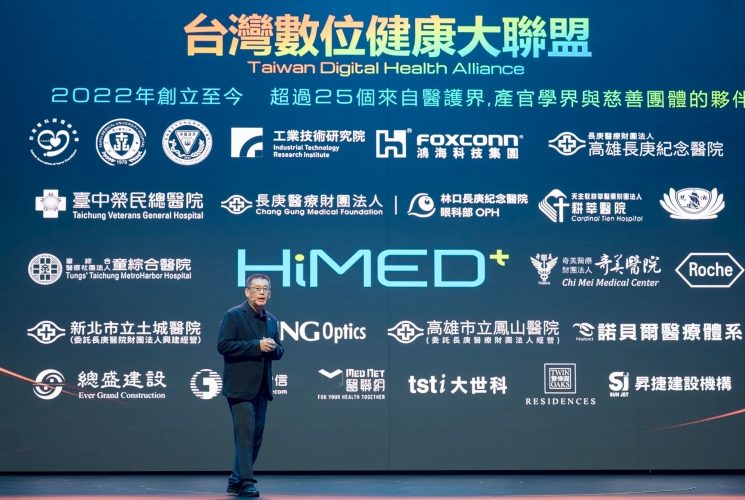
Barry Chiang, President of Hon Hai's B Business Group, discusses the collaborative progress of the Taiwan Digital Health Alliance (HiMEDt) at the 2025 Hon Hai Tech Day. (Image: Hon Hai)
As tech giants flock to the fields of artificial intelligence and robotics, Barry Chiang, who leads the B Business Group that oversees business in digital home appliances, digital health and robotics at Hon Hai Technology Group (Foxconn), has articulated the company's vision for the medical sector. Hon Hai is transforming from a traditional hardware manufacturer into a technology ecosystem integrator. Their core strategy revolves around the integration of AI, robotics, and smart hospitals, aiming to create a complete "cloud-edge integration" solution. This approach targets the high-barrier medical industry.
AI Medical Models: Wisdom Transformed Into Digital Form
Chiang noted that Hon Hai's medical journey began with its multi-modal medical models. He calls these models "Taiwan's Sovereign AI", emphasizing that Taiwan's greatest strength lies in the combination of its ICT industry and medical data. Instead of using open-source large language models (LLMs), Hon Hai's AI medical models utilize "small models" with parameters under 10 billion. These models are designed to be closed and specialized, trained with data from within hospitals, and are primarily used for auxiliary diagnosis.

HiMEDt brings together cross-disciplinary experts to jointly advance smart healthcare. (Image: Hon Hai)
These models cover various medical specialties, including:
- Cardiology: The single-lead ECG for atrial fibrillation helps track a patient's daily data for early warning, preventing strokes. Chiang mentioned that this product was designed five years ago, perfectly catching the current trend.
- Ophthalmology: Focused on macular degeneration and retinal diseases, the model transforms the diagnostic wisdom of senior doctors into a digital format, helping younger doctors with their diagnoses.
- Pulmonology: Targeting major conditions like lung cancer and adenocarcinoma, the AI assists in diagnosis and passes on the experience of veteran physicians.
- Urology: The prostate model helps doctors pinpoint lesions more accurately, reducing the need for invasive biopsies.
Chiang stated that the creation of these professional models relies on collaboration with major hospitals, using a "Federated Learning" approach. This method encourages hospitals to collectively train the models without sharing raw data, and through "debate and arguing" among different doctors, they can eventually establish the most precise diagnostic criteria.
Smart Hospitals: A Practical Field for Robots and Digitalization
Hon Hai's medical strategy isn't limited to software; its ultimate blueprint is a complete "smart hospital" solution. The Nurabot nursing collaborative robot plays a vital role in this plan. Unlike traditional Autonomous Mobile Robots (AMRs), this collaborative robot's key feature is its "Design Thinking" methodology. It starts with user experience rather than being purely technology-driven.
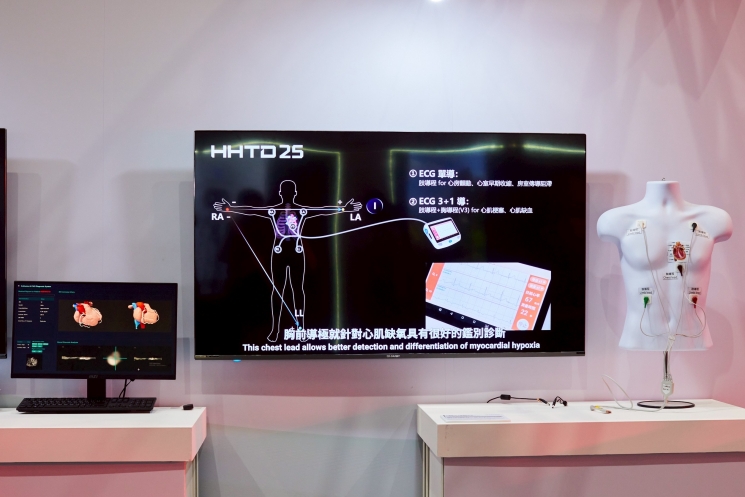
Hon Hai actively listens to voices from the medical frontline and develops smart medical devices accordingly. (Image: Hon Hai)
Chiang explains that the robot's core advantage lies in its powerful "cloud computing" capability, not the hardware itself. It's a complex platform where four cloud systems—FoxBrain, NVIDIA Omniverse™, HIS, and NVIDIA Jetson AGX Orin™ edge computing—work in concert to deliver a high level of automation and collaboration. After completing over four months of rigorous, multi-stage stress testing in real hospital environments at Taichung Veterans General Hospital, Nurabot has transitioned into daily clinical operation—marking an important milestone toward the practical integration of smart medical robotics into routine clinical workflows.
Navigating Challenges in Biotech and Healthcare
Chiang outlined three main hurdles from his first-hand observations and management experience. First, the medical industry's slow adoption of new technologies, with validation cycles often lasting months or even years, contrasts sharply with the rapid innovation pace of the tech sector. Second, the linguistic gap between different fields is a major obstacle. Engineers and medical professionals often have different understandings of needs, requiring someone to effectively communicate technological terms into clinically viable solutions. Third, the business model is still evolving. The company must constantly figure out how to balance costs and scalability while creating tangible clinical value.
To address these challenges, Chiang leads his team with a three-pronged approach: First is co-creation. Through the Taiwan Digital Health Alliance (HiMEDt) ecosystem, they collaborate with multiple hospitals, government bodies, and academia to ensure solutions meet clinical needs. Second is iteration, where they adopt a strategy of small-scale pilots and rapid validation before gradual implementation, which minimizes risks. Third is cross-disciplinary communication. The company specifically cultivates project managers with medical backgrounds to ensure a genuine understanding of each other's language and needs when collaborating with hospitals.
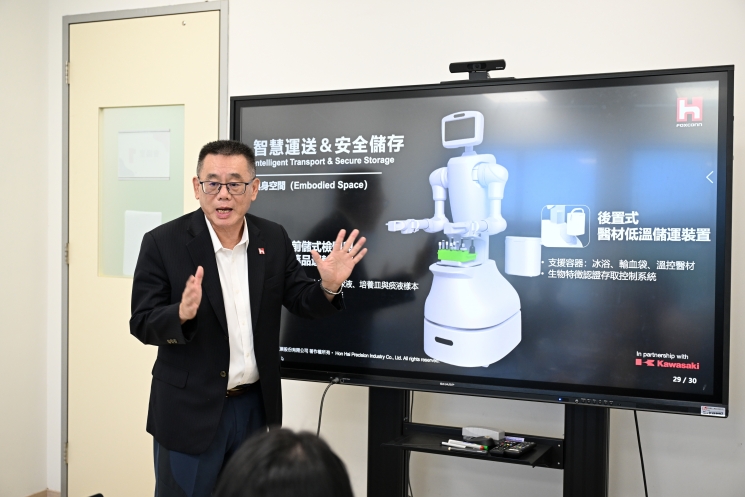
Barry Chiang points out that nursing robots are part of Hon Hai's medical strategy, with all R&D efforts aimed at building smart hospitals.
Chiang believes that technology can only deliver true value when it genuinely understands the needs and user experience of the medical frontline. This is why Hon Hai has assembled a cross-disciplinary team of talents in biomedical engineering, biostatistics, computer science, industrial design, and user experience. This team acts as a solid bridge between healthcare and technology, which is the direction of Hon Hai's efforts in digital health.
Future Outlook: From Manufacturing to Ecosystem Integrator
Chiang contextualizes the medical strategy within Hon Hai's broader corporate vision, known as "3+3+3". The first “3” refer to Hon Hai's core business platforms, which are all part of the FoxBrain ecosystem:
- Smart Manufacturing
- Smart EV (Electric Vehicles)
- Smart City, which includes Smart Healthcare
This strategy signifies a major shift from hardware manufacturing to a focus on software and system integration. Hon Hai aims to become a "Platform Problem Solver" and "Content Provider". He believes that this integrated approach of providing a "Total Solution" is what distinguishes Hon Hai and what the market is now demanding.
Hon Hai's medical strategy is not about isolated breakthroughs; it's about making the smart hospital the "end point," integrating all AI models, robots, and digital systems into one. Chiang refers to this strategy as being a "Platform Problem Solver," with the goal of providing hospitals with a "Total Solution" rather than just a single product.
He believes Hon Hai's investment in the medical field is a strategic move for a future with high market barriers. Unlike consumer products, the medical industry requires years of clinical validation and regulatory approval. However, once successful, it establishes a formidable competitive wall that's difficult to breach.
With the government's push for "smart hospitals," Hon Hai's digital health strategy is closely aligned with the government’s five-year "Healthy Taiwan Cultivation Plan". Hon Hai expects to see returns starting in 2026. Moving forward, the company plans to replicate this model in other hospitals in Taiwan and look towards the global market, especially in countries facing nursing shortages. This transformation will see Hon Hai evolve from a traditional manufacturing giant into a leader in the global smart healthcare ecosystem, bringing new possibilities for human health.
【Further Reading】Foxconn's Healthcare Robot to Revolutionize Patient Care
(Writer: Judy Lin/Editor: Lihua Wang)